
Building Leaders by Building Each Other: Inside a Transformative NYCHA Mentorship
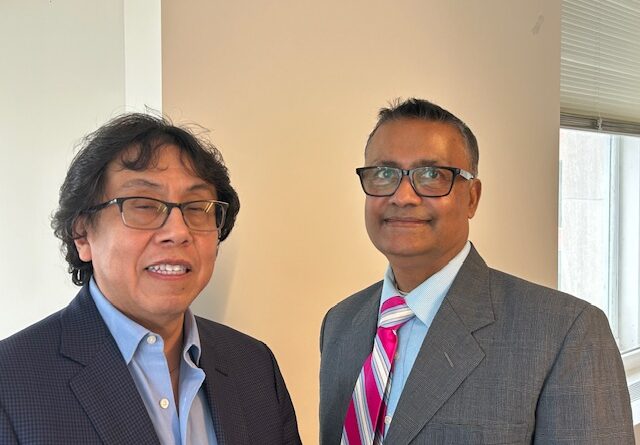
When Miguel Ballena and Avik Das first crossed paths at NYCHA, they didn’t share much more than a nodding acquaintance in the hallways of 90 Church Street. Each man worked in a different corner of this vast organization — Mr. Ballena in Performance Tracking and Analytics, Mr. Das in Internal Audit and Assessment. Then NYCHA’s Coaching and Mentoring Leadership Academy (CMLA) brought them together in a transformative way.
“Not perfection — your true experience.”
When they first sat down, Mr. Ballena — now serving as a mentor after having been a mentee in last year’s CMLA cohort — offered one simple guideline: Perfection isn’t the goal, authenticity is. With that, he set a tone of openness rather than hierarchy.
For Mr. Das, new to the program and eager to jump in, it was a revelation. He soon saw that he had been paired not just with a mentor but with a humane gentleman whom he now describes as “one of my close friends.” Their discussions quickly expanded beyond “just work.” They talked about their shared experiences as immigrants, about their families, about their love of painting and art, about the real pressures and rewards of public service.
In short, Mr. Das enthused, the CMLA program has “opened up my mind!” With his mentor’s guidance, it became clear that the CMLA assignments — writing goals, planning steps, thinking strategically — facilitated growth and contemplation on what it truly means to lead within a community.
“We never spoke before; now we communicate every day,” Mr. Das said.
A mentor who was once a mentee
Last year, it was Mr. Ballena who was sitting on the mentee side of the CMLA table. “It’s so helpful to have gone through the CMLA journey myself,” he said. A 30-year NYCHA veteran, he has long believed one of the agency’s great resources lies in the possibility of connection. Coaching revealed itself as a natural extension of the mentorship he’d tried to provide, if informally, throughout his career: spotting people’s talents and encouraging them to expand their sense of what might be possible.
Now nearing retirement, Mr. Ballena’s mentoring efforts have become a way to create something lasting. “If you can inspire change in just one person,” he said, “they will be inspired to bring that joy, that motivation, to others.”
Disruption – in a good way
The CMLA program disrupts old patterns quite intentionally. Weekly conversations build trust. Monthly cohort meetings forge community. Leadership tools, writing workshops, and résumé reviews create practical growth.
Both men say they have become better listeners. Their communication styles have shifted — from transactional to human-centered. Their sensitivity to colleagues’ lived experiences has deepened. And they have discovered a shared desire to pass on what they have received.
Their relationship has also created ripple effects. Networking feels more natural. Collaboration has new depth. Their work is getting done faster and better, with greater ease and goodwill.
As Mr. Ballena put it: “When you suspect you may have touched someone’s life—it touches your soul as well.”


