
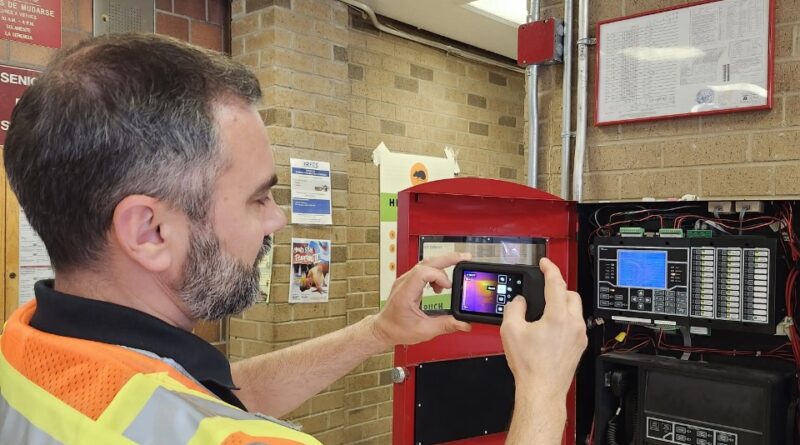
The FLIR Thermal Imaging Camera That’s Improving Fire Safety at NYCHA
Preventing fires across NYCHA’s 300-plus developments is a challenge that requires both expertise and creativity. NYCHA’s Fire Safety Department — led by Senior Director Joe Terranova — is driven by both, constantly seeking new technologies to carry out its mission.
The team’s work involves not just traditional fire management but also the quick detection of invisible threats — hotspots, leaks, and electrical faults —using the latest tools. One such tool has proven transformative: a forward-looking infrared (FLIR) thermal imaging camera.
Seeing the Unseen
Unlike standard cameras, the FLIR uses infrared to “see” heat. It detects temperature differences and displays them in vibrant colors — cool blues, warm reds, fiery oranges.
“Whenever there’s a temperature differential, it concerns what we do,” said Mr. Terranova. “The FLIR camera gives us a visual display of temperature differences not visible to the naked eye.”
For the Fire Safety team, the camera has been a game changer. Whether inspecting fire alarm panels, checking pumps, or tracking underground leaks, the FLIR delivers instant insights that once took hours — or even days — to uncover.
Diagnosing the Invisible
Take fire alarm systems. Their panels contain circuits, power supplies, and batteries. Loose connections or corrosion can cause overheating, leading to failures or fires. With the FLIR, the team can “see” those hotspots instantly.
“Every time our fire alarm team opens a panel, they take an infrared picture to check for overheating components or high-resistance connections,” said Mr. Terranova. “It’s electrical thermography in action.”
And before entering a post-fire scene, Mr. Terranova uses the camera to spot hidden hotspots or live circuits in waterlogged areas. “I want to make sure there isn’t a hidden hotspot that could flare up or an appliance that could rekindle,” he said.
The camera also excels in plumbing diagnostics, where “cold spots” are the giveaway. Comparing pipe temperatures to surrounding walls, the team quickly spots water flow where it should not be. “In the past, it took a dozen people several hours to isolate valves and look for leaks and determine which pipe it’s coming from” Mr. Terranova said. “Now, in minutes, we know if the piping is leaking or not.”
The FLIR has saved NYCHA time and money on numerous occasions. For instance, at a Manhattan development, the source of a flooded playground was identified within 15 minutes, enabling immediate repair.
From Military Tech to Maintenance Marvel
FLIR originated as military night vision technology. By the 1990s, bulky, costly thermal cameras had been adopted by fire departments across the country. Today, compact and affordable models (like the kind NYCHA uses) have entered civilian maintenance.
NYCHA bought its first FLIR cameras in April 2024 for the fire alarm team. Since then, their use has expanded across plumbing, special projects, and preventive maintenance — checking rooftop pipes in winter, pump motors in basements, and more – all in service to residents’ health and safety.


